






The numbers tell a stark story. Amid technological disruption, economic volatility, and geopolitical uncertainty, 51% of CHROs now rank leadership development as their top priority, nearly double any other strategic initiative, according to recent research from the Society for Human Resource Management. Leaders know they can’t hire their way out of today’s challenges. They must develop the leaders they have—and fast.
Yet most leadership development programs aren’t built for the moment we’re in. They’re
anchored in outdated playbooks and ineffective at meeting today’s challenges. They overemphasize the assessment of traits people already possess and undervalue the behaviors they can still develop.
In particular, too many leadership development programs fall back on empty jargon and vague concepts that lack clear direction for tactical action. They rely on abstract concepts or buzzy catchphrases that sound good in boardrooms but prove impossible to implement on the ground. (“Move the needle” might sound good on your corporate swag, but it’s too unclear for many people to put into practice.) As a result, the return on investment remains disappointingly low. Despite decades of effort and billions spent, research consistently shows that training fades within weeks as people revert to old habits, especially when the organizations they work in don’t change, too.
What Actually Works: Modern Leadership Behaviors
Our research and experience working with nearly 600 organizations suggest most programs lack the concrete, specific behaviors that managing today’s workforce demands. Both have consistently shown that leadership development needs to be focused on coachable leadership behaviors that are specific, precise, and scalable. Rather than vague pronouncements such as “be a talent magnet” or "push boundaries,” programs need shared language focused on concrete behaviors that translate easily into action—things like actively seeking out feedback, setting clear goals for individual projects, and connecting employees to things like wellness programs. We call these tactical, unambiguous actions “Modern Leadership Behaviors.”
The impact of using them is measurable and dramatic. When comparing leaders who almost never practice Modern Leadership Behaviors to those who almost always practice them, our research found their direct reports’ experience ratings—on things like their sense of belonging or empowerment—were roughly 170% higher. Even minor shifts in behavior deliver substantial gains. Leaders who demonstrate these behaviors “almost always” outperform those who demonstrate them “often”—just one step up on the frequency scale—by roughly 20%.
Experiences like belonging, purpose, and empowerment may seem personal or inconsequential, but they have far-reaching implications. A wide body of research indicates these experiences translate into tangible benefits, including higher productivity, stronger retention, greater innovation, and improved financial performance. Studies, for example, show that fostering a keen sense of belonging can increase job performance by more than 50% and cut turnover risk in half.
The Science Behind the Solution
We built this framework through a rigorous series of studies that included interviews with leadership experts and C-suite executives, guidance from work psychology researchers, and a demographically representative sample of more than 6,500 direct reports and leaders across multiple job levels and industries.
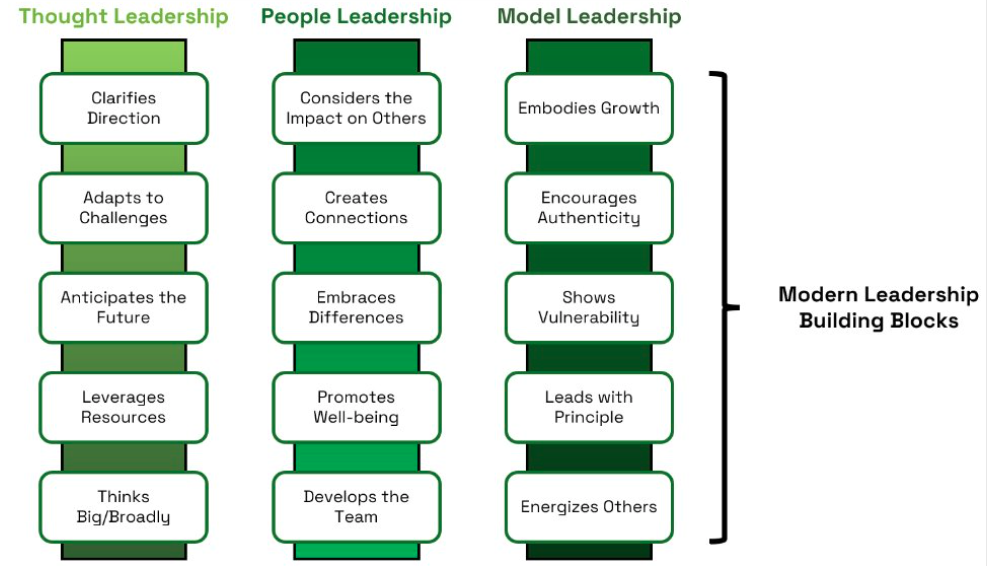
The process led us to nearly 80 Modern Leadership Behaviors that we organized into 15 related groups and clustered into three broad categories. These define what we call "Modern Leaders.” They are:
Thought leaders: Shaping the future with clarity, empathy, and agility.
People leaders: Building strong, collaborative teams by investing in people personally and professionally.
Model leaders: Inspiring others by setting an example of authenticity, integrity, and having a growth mindset.
One of the real superpowers of Modern Leader Behaviors is that they don’t require organizations to replace what they already have. Our framework provides precise behaviors that bring concepts to life, making them more practical and easier to act on. Rather than relying on broad corporate values or abstract leadership “competencies,” they offer leaders a clear direction on what they can do. They simply clarify the language, using unambiguous behaviors that won’t get lost in translation.
A Talent Amplifier
In our current do-more-with-less era, making leadership development more effective amplifies the talent you have. Its influence is especially visible in four high-stakes areas:
Organizational culture and change: Developing specific behaviors provides leaders with a blueprint for guiding people through uncertainty. They don’t just communicate a vision; they prompt real action.
Team optimization: When leaders show up consistently and clearly, teams follow suit. Trust deepens, collaboration improves, and performance increases.
Succession planning: Effective leadership frameworks make the future less ambiguous, surfacing who’s ready to step up and what they still need to succeed.
Individual growth: Strong leadership frameworks focus on coaching people no matter their starting point, making growth more focused, actionable, and measurable.
But the opportunity goes beyond organizational boundaries. If we redefine leadership development to be driven by concrete, coachable behaviors rather than hollow slogans or ill-defined concepts, we can start to shift outdated ways of thinking about leadership to a mindset that captures its potential. If you want to change a company—and ultimately, how business operates in society—start with how leaders behave.